6,000 Immigrants Have Left Portugal in 2026. Here Is Why I Think This Is Good News for Serious Investors.
By Sylvia Awoudu · June 3, 2026 · 10 min read read · Expats
Before I say anything else I want to acknowledge something. Behind every statistic in this story there is a real person. Someone who built a life in Portugal, learned the language, paid taxes, raised children here, and is now leaving because the system made it impossible to stay. That is painful and it deserves to be said plainly.
Now let me tell you why I think what is happening in Portugal right now, taken as a whole, is actually a signal that this country is heading in the right direction. why I believe this is precisely the moment to take Portugal seriously, not to walk away from it.
What the Numbers Actually Show
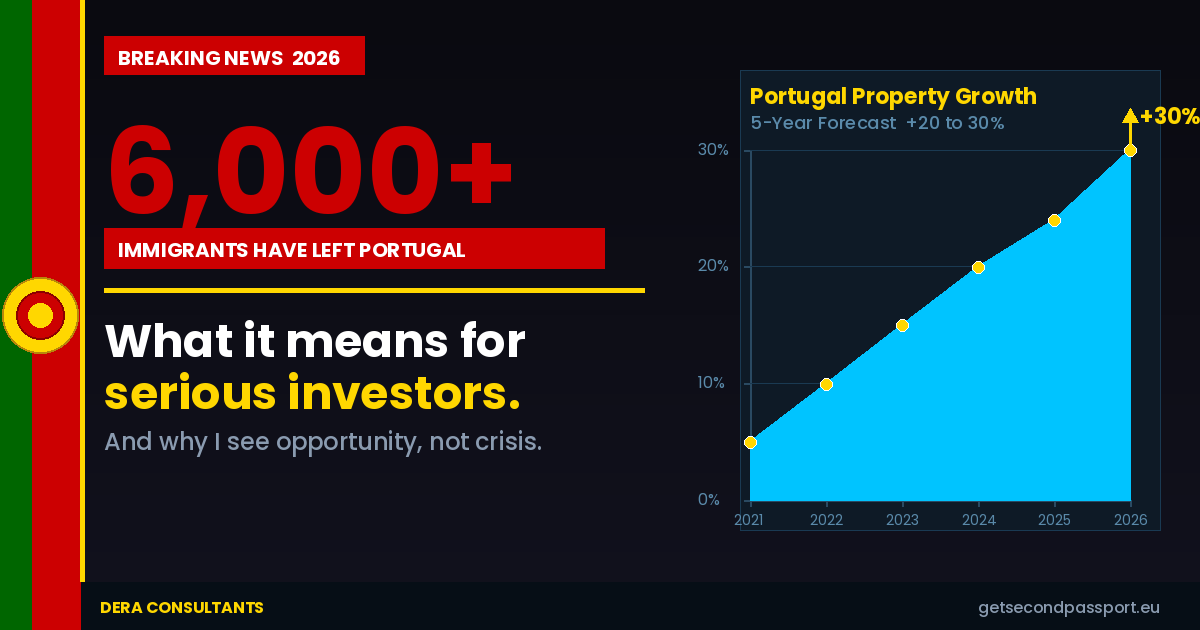
More than 6,000 immigrants have left Portugal since the beginning of 2026 according to data published by Expresso, with the number expected to increase in the coming months.
The reasons are a combination of factors that have been building for two to three years. A severe housing crisis has pushed rents beyond what many low-wage workers can afford. AIMA, the agency responsible for processing residency applications, has been dealing with a backlog that at its peak reached over 400,000 pending cases. Workers have been operating in legal limbo for years, unable to renew documents on time, unable to take jobs that require residency proof, and in many cases unable to access basic services while they waited.
At the same time, the government has been accelerating removals. AIMA reviewed 184,059 applications and rejected 33,983 of them, an 18.5 percent rejection rate. Those people are receiving voluntary departure notifications. Thousands of workers, particularly in transport, construction, and services, have already disappeared from official records as their permits expired and AIMA could not process renewals in time.
This is the context for the 6,000 figure. Some left because they chose to seek better opportunities elsewhere in Europe. Some left because their legal status became untenable. Some were asked to leave.
I live in Portugal. I see this firsthand. The Brazilians I know who have been here for a decade are worried. The construction workers from South Asia who built half of Lisbon's new developments are being handed notices. There is real human cost in what is happening and I am not going to pretend otherwise. But I am also going to tell you what I see when I look at this situation through the lens of someone who works with investors and serious residents every single day.
What Portugal Is Actually Doing
The Portuguese government's position has shifted significantly from where it was five years ago. Prime Minister Montenegro has been explicit. Portugal cannot have wide-open doors. The priority is now qualified professionals, students, people from Portuguese-speaking countries, and family reunification. The minister responsible for immigration stated publicly that the era of leniency in immigration in Portugal is over.
That framing will make some people uncomfortable. But what it describes, underneath the political language, is a country that is trying to build a more selective and sustainable immigration framework. One where the people who come are equipped to integrate, contribute, and build something lasting. One where residency is earned and documented rather than informally assumed.
Portugal's foreign-born population officially reached 1.5 million people by the end of 2024, representing nearly 12 percent of the total population. That growth was extraordinary and it was largely unplanned. The housing market, the public services, and the immigration system were not built to absorb that volume that quickly. The current reset, painful as it is, is a structural correction.
Why I See Opportunity Where Others See Crisis
Here is the perspective shift I want to offer. I say this not to be contrarian but because I genuinely believe it based on what I see working with clients who are building real lives and real investments in this country.
Portugal is not closing. It is becoming more selective.
There is an enormous difference between those two things.
A country that closes its doors to everyone is a dead end. A country that raises its standards and becomes more intentional about who it welcomes is a country that is investing in its own future. countries that invest in their future become better places to live, do business, and build wealth over time.
What the current policy shift means in practice is that the people who are coming to Portugal going forward will have gone through a more rigorous process. Their documentation will be in order. Their income will be verified. Their intentions will be declared and legitimate. That creates a more stable, more predictable environment for everyone who is already here and for everyone who is planning to come.
For the investor considering a D7 or a Golden Visa, this is actually good news. You are not competing for AIMA appointments with 400,000 unprocessed cases anymore. The government's claim that 93 percent of the backlog has been resolved means the system is clearing. Qualified applicants going through the proper channels are moving faster than they were two years ago.
What This Means for Different Types of Applicants
| Applicant Type | What the Current Environment Means |
|---|---|
| D7 applicant with documented passive income | Cleaner queue, more predictable processing, less competition for appointments |
| D8 Digital Nomad with verified remote income | Same benefits as D7, clearer pathway as the informal economy tightens |
| Golden Visa investor | Programme continues, backlog reducing, AIMA focusing on qualified applicants |
| Person trying to come informally without documentation | Significantly harder environment, higher risk of rejection and removal |
| Qualified professional in a shortage sector | Actively welcomed under the new priority framework |
The pattern is consistent. If you are going through the right process with the right documentation and the right support, Portugal is actually becoming easier to work through, not harder. The difficulty is concentrated among those who were in informal or undocumented situations.
The Housing Argument
One of the reasons immigrants are leaving is the housing crisis. Rents in Lisbon, Porto, and even smaller cities have risen to levels that make Portugal unviable for low-wage workers. A construction worker earning the Portuguese minimum wage cannot afford to live in the city where he works. That is a real and serious problem.
But from a property investment perspective, this same dynamic tells a different story. The demand for Portuguese property consistently outstrips supply. New housing is being built but not fast enough. The structural gap between what is available and what is needed is exactly what makes Portugal's property market compelling for investors with the right strategy and the right legal structure.
The people leaving Portugal are largely concentrated in the low-wage labour sectors. The people who should be thinking about coming, with investment capital, documented income, and a medium to long-term strategy, are in an entirely different position relative to the current market.
The Selective Immigration Argument
I want to make this point clearly because I think it is the most important one.
Every country that has a functioning, respected immigration system is a selective immigration system. Canada selects for skilled workers and investors. Germany selects for qualified professionals. Australia uses a points-based system. The UK has its own income thresholds and visa categories.
Portugal, for many years, had a more relaxed approach. That created economic activity but it also created the backlog, the housing pressure, and the integration challenges that are producing the current correction.
What Portugal is moving toward is not exclusion. It is intentionality. intentional, selective immigration systems tend to produce better outcomes for both the receiving country and the people who come through them properly.
The D7 visa, the D8, and the Golden Visa are all examples of intentional, selective pathways. They require you to demonstrate something. Income, investment, professional status, or business viability. They require documentation. They require a lawyer and in most cases an advisor who knows the system.
That barrier to entry is not a problem. It is the filter that ensures the people who come through are genuinely ready to be here.
The moment I am most excited about Portugal is not when the headlines are all positive and everyone wants to come. The moment I am most excited is when the noise clears and what is left is a system that rewards preparation and penalises shortcuts. That is exactly where Portugal is right now. The people who are serious, who are willing to do this properly, and who have the right support around them are going to find a more welcoming and more functional system than the one that existed two years ago.
What You Should Do Right Now
If you have been watching Portugal from a distance and the recent headlines have made you uncertain, I want you to reframe the question you are asking yourself.
The question is not: is Portugal welcoming immigrants? The answer to that question is complicated right now and depends entirely on which immigrants you are asking about.
The question to ask is: is Portugal welcoming qualified, documented, financially independent residents and investors who go through the proper channels? The answer to that question is yes, and the answer is getting clearer every month.
Permanent residency at five years is unchanged. Schengen access is immediate from day one. The property market fundamentals are strong. The quality of life remains exceptional. The pathway to an EU passport, while longer at ten years, is still one of the most powerful long-term strategies available to anyone building a global life.
If you are ready to do this properly, with the right documentation, the right structure, and the right people around you, this is actually one of the better moments to start.
If you want to understand exactly what your pathway into Portugal looks like and what you need to have in place before you take the first step, book a consultation and we will map it out together.