What Is the Real Processing Time for Dominica Citizenship by Investment in 2026? Not What They Are Advertising.
By Sylvia Awoudu · June 26, 2026 · 9 min read read · Citizenship
Let me be direct about something the brochures do not tell you.
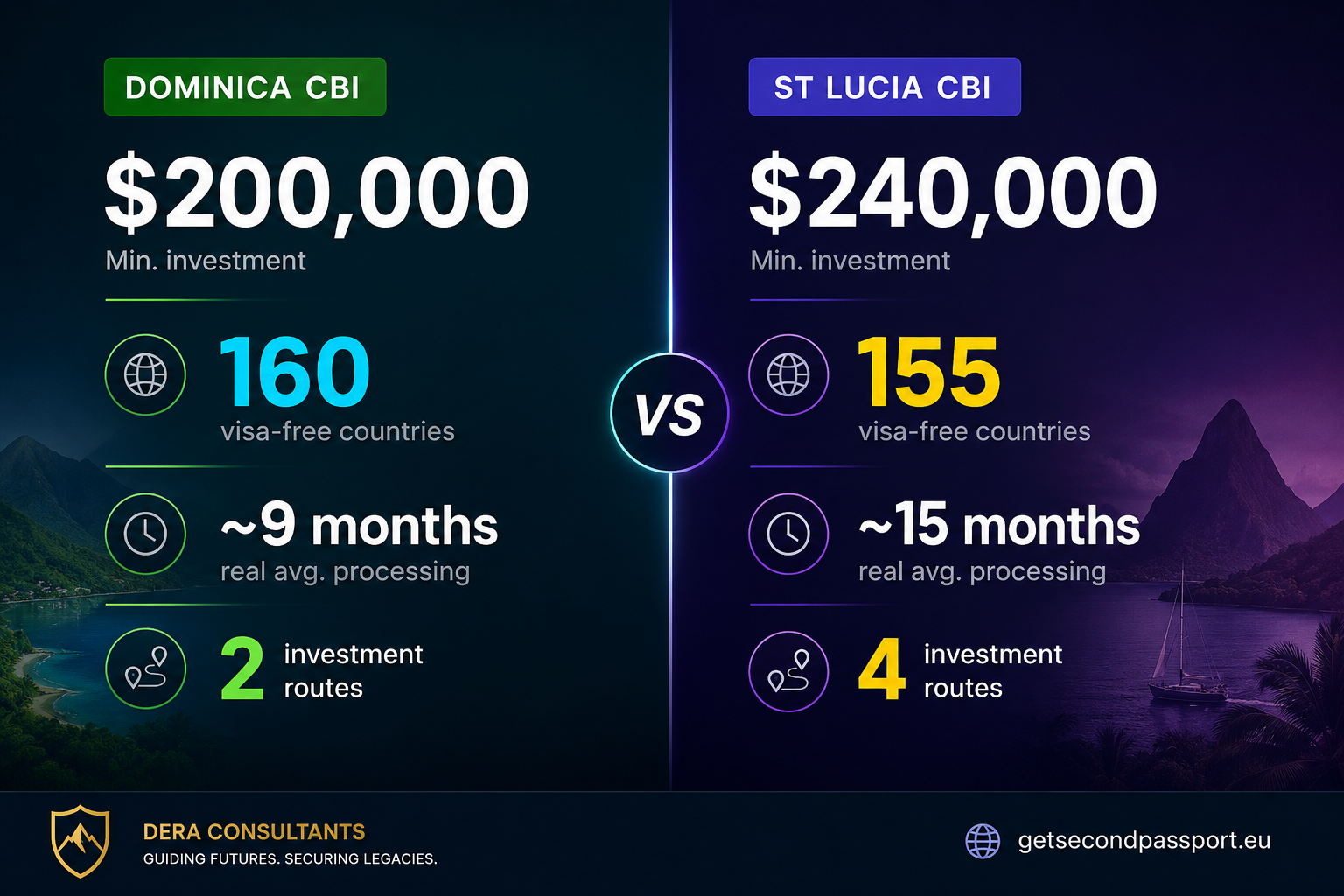
Every Dominica CBI programme summary you will find online advertises a processing time of three to six months. That figure is not accurate for 2026. The real average is running closer to nine months, and for certain applicant profiles it is running longer.
This is not a crisis. The programme is still working. Passports are still being issued. But if you are making business plans, travel plans, or family decisions based on a six-month timeline, you need to adjust that expectation now rather than after you have submitted your application.
What the Official Timeline Says
The Dominica Citizenship by Investment Unit publishes a processing framework that describes the following stages after a complete application is submitted.
First, due diligence and background checks are conducted on all applicants. This stage typically takes sixty to ninety days under normal processing conditions. Second, the application is reviewed by the CBI Unit and a decision in principle is issued. Third, the investor completes the qualifying investment within sixty to ninety days of approval in principle. Fourth, the passport and naturalisation certificate are issued within two weeks of the investment being confirmed.
On paper this sequence suggests a total timeline of approximately four to six months from submission to passport. In practice, each of these stages is currently taking longer than the published framework suggests.
What Is Actually Happening in 2026
The current real average processing time for Dominica CBI applications is approximately nine months from submission to passport receipt. Some straightforward applications from lower-risk applicant profiles are completing closer to six months. Applications involving enhanced due diligence are running longer, in some cases twelve months or more.
Three specific factors are driving the extension.
Factor 1: ECCIRA and Enhanced Due Diligence
In September 2025, Dominica signed the ECCIRA agreement alongside Antigua and Barbuda, Grenada, St Kitts and Nevis, and St Lucia, establishing a regional regulatory authority for Caribbean CBI programmes. One of the immediate practical consequences was the harmonisation of due diligence standards across all five programmes.
Previously, programmes competed partly on the speed and lightness of their due diligence process. Under ECCIRA, all five programmes now apply the same enhanced background check requirements. Every application, regardless of nationality or risk profile, goes through the same thorough process. This adds time uniformly.
This is actually a good development for anyone who wants their passport to hold its value long term. A stricter, more credible programme is a more respected passport. The extra weeks of processing are an investment in the long-term standing of the document you are acquiring.
Factor 2: The Mandatory Interview
Since July 2023, all applicants aged sixteen and over are required to complete a mandatory interview as part of the Dominica CBI process. These interviews can be conducted in person on the island or online. They are designed to verify the applicant's identity, the source of their funds, and their understanding of the programme.
For most legitimate applicants this is a straightforward step. It is not designed to be an obstacle. But it does add a scheduling step to the process, and during peak application periods interview slots have a waiting period of several weeks before availability opens.
The interview fee is $1,000 per applicant and is included in the total cost of the application.
Factor 3: Application Volume
Dominica remains the most affordable Caribbean CBI programme at $200,000 minimum. In a market where Grenada starts from $235,000, St Kitts from $250,000, and St Lucia from $240,000, the price differential consistently drives higher application volumes to Dominica. Higher volume means longer queues.
What This Means for Different Applicant Profiles
Not all applicants experience the same timeline. Here is a realistic guide based on current processing patterns.
| Applicant profile | Realistic timeline |
|---|---|
| Single applicant, straightforward background, complete documentation | 6 to 8 months |
| Family application, clean backgrounds, complete documentation | 8 to 10 months |
| Any applicant from a country on the enhanced due diligence list | 10 to 14 months |
| Applications with incomplete documentation at submission | Add 2 to 4 months to any of the above |
West African applicants, including Nigerians and Ghanaians, are subject to enhanced due diligence as standard. This is not a rejection signal. It is a process requirement that adds thorough background verification to the application. The outcome for a legitimate applicant with clean documentation and transparent source of funds is still approval. It simply takes longer.
The Most Common Way People Slow Down Their Own Application
In my experience working with clients on Caribbean CBI applications, the single biggest cause of delays beyond the standard processing time is incomplete or incorrectly prepared documentation at submission.
The CBI Unit will pause review of an application if supporting documents are missing, incorrectly certified, outdated, or inconsistently formatted. Recovering from a documentation pause can add two to four months to the total timeline because you are effectively re-entering the queue once the missing items are provided.
The categories where documentation problems most commonly arise are source of funds evidence, criminal record certificates that have expired or been incorrectly apostilled, bank statements that do not cover the required period in the required format, and passport copies that are unclear or from a document that will expire during the processing period.
An advisor or lawyer who has submitted Dominica applications recently knows exactly what the CBI Unit wants to see and how they want to see it. Getting the documentation right before submission is worth far more than any promised accelerated timeline.
The Accelerated Processing Question
Dominica does offer an accelerated processing option for certain applicants. If you have seen this mentioned, it is a real programme feature, but it applies to a narrow set of circumstances and comes with additional fees and requirements.
It is not a way to skip the queue. It is a specific pathway for applicants who have a documented urgent need and who meet additional eligibility criteria. I strongly recommend not relying on accelerated processing as a strategy for getting your passport faster. Build your timeline around the standard process and treat any speed as a bonus.
The Honest Planning Framework
If you are considering Dominica CBI and are thinking about timelines, here is the framework I give every client.
Plan for twelve months from the moment you begin preparing your documentation to the moment the passport is in your hand. If it arrives in nine months, you are ahead. If enhanced due diligence adds a few extra months, you have not been caught off guard.
Do not make any irreversible travel, business, or family decisions that depend on having the passport by a specific date unless that date is at least twelve months away.
Start the documentation preparation before you submit the application, not after. Every week you spend gathering documents before submission is a week you avoid adding to the end of the process.
Work with an advisor who has submitted successful Dominica applications in the past twelve months and can show you current realistic timelines from their own client portfolio. Anyone quoting you three to four months in mid-2026 is either uninformed or telling you what you want to hear.
If you want to understand exactly what your Dominica CBI application would look like based on your nationality, family structure, and investment budget, book a consultation and we will map it out clearly before you commit to anything.