Portugal's Golden Visa Backlog: What the Government Just Admitted, and What It Means for Your ARI
By Sylvia Awoudu · November 4, 2026 · 9 min read read · Expats
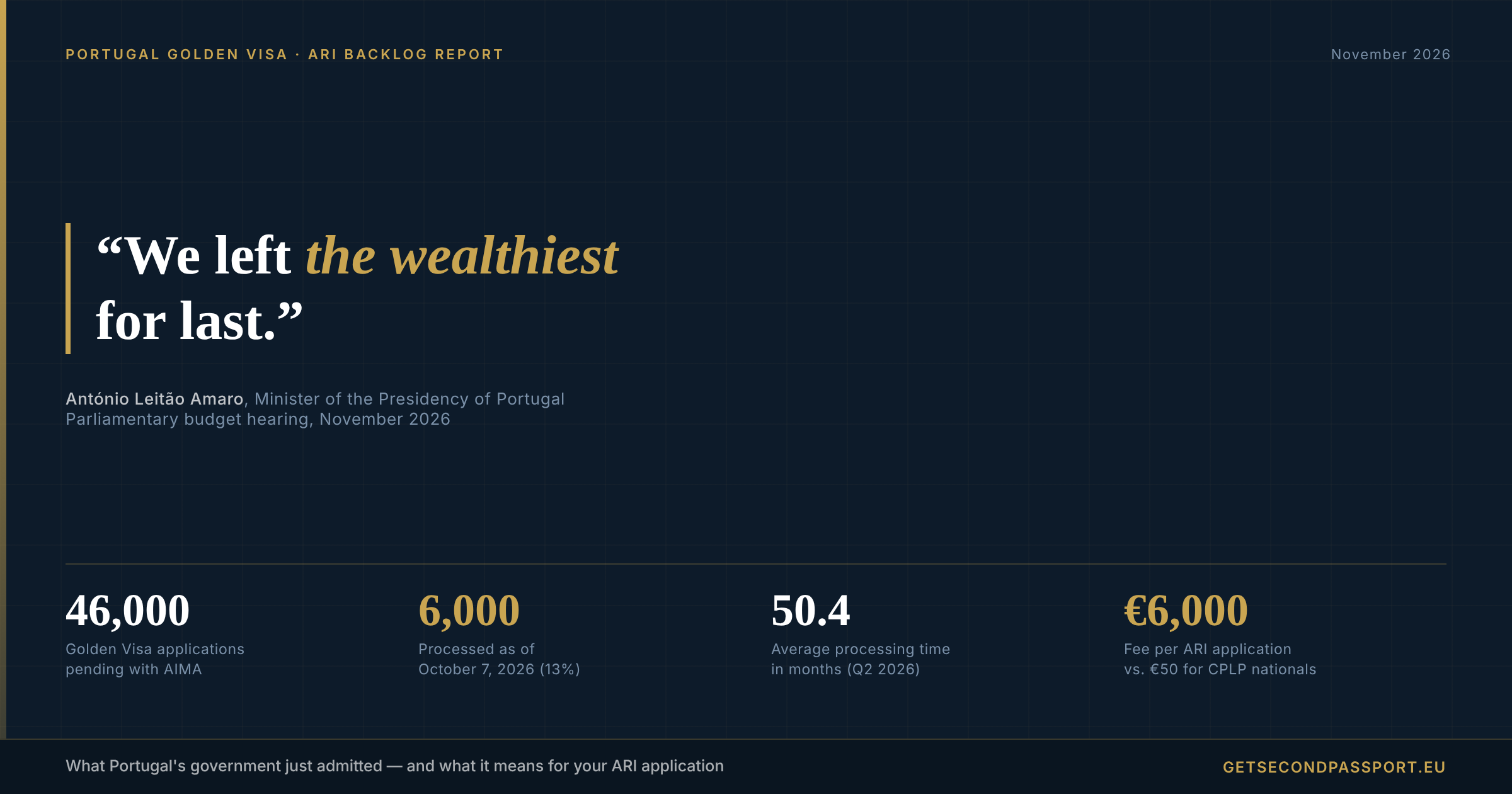
In November 2026, Portugal's Minister of the Presidency, António Leitão Amaro, appeared before a parliamentary budget hearing and said something that stopped a lot of investors in their tracks. When asked about the state of ARI applications, he said: deixámos os mais ricos para o fim. We left the wealthiest for last.
He said it in the context of defending a priority system that put humanitarian cases, which it should, ahead of investment-based residency applications. That part is understandable. What is harder to defend is what the numbers actually look like on the ground right now.
I work with clients going through this process. I have watched the Portugal Golden Visa backlog grow. This article is not meant to scare you away from Portugal. It is meant to give you the accurate picture before you make decisions based on a timeline someone told you three years ago.
The numbers behind the backlog
| Measure | Figure |
|---|---|
| ARI applications pending with AIMA (October 2026) | 46,000 |
| Processed as of 7 October 2026 | 6,000 (13 percent of pipeline) |
| Average processing time, Q2 2026 | 50.4 months (a record) |
| ARI fee per application | €6,000 |
| CPLP national fee for the same residency pathway | €50 |
As of October 2026, AIMA has 46,000 ARI applications pending. Of those, approximately 6,000 have been fully processed. That is 13 percent of the total pipeline cleared in the entire life of the backlog.
The average processing time for a single application hit 50.4 months in the second quarter of 2026. That is a record, and not the kind you want your money sitting inside. If you are a new applicant today, the realistic timeline from submission to your first residence card is between 14 and 18 months under current conditions.
AIMA processed roughly 30,000 biometric appointments in 2026. The bottleneck has shifted. It is no longer about scheduling those appointments. The pipeline is now congested between biometrics completion and the actual decision on the application. Work is happening, but not fast enough to close the gap at the current rate.
What the minister's admission actually means
"We left the wealthiest for last." António Leitão Amaro, Minister of the Presidency of Portugal, parliamentary budget hearing, November 2026.
The minister was not being careless with his words. He was explaining a triage logic: when resources are stretched, you prioritise people whose lives are most at risk. Workers, refugees, and humanitarian cases come first. Investors, by definition, can wait.
But the investors who are waiting now submitted their applications in 2022, 2023, and 2024. They were not told they were going to the back of the queue. They were told they were making a smart long-term investment in a stable European country with a clear path to residency and citizenship.
The honest version of that statement is still true. Portugal is still a stable European country with a path to residency and citizenship. But the timeline of that path has changed in ways that matter significantly, and that is what I want to walk through with you.
The citizenship timeline has changed, not in your favour
This is the part that most people are not talking about clearly enough, and I think they should be.
On 29 October 2026, Portugal changed its citizenship law. The residency requirement for non-EU nationals applying for citizenship was extended from five years to ten years. Read that again. Ten years of legal residency before you can apply for a Portuguese passport.
Now combine that with what the ARI processing backlog means in practice.
What the numbers actually mean for you. Submit an ARI application today. Your first residence card arrives in 2028, at the earliest. Your citizenship clock does not start until that card is issued. Under the new ten-year law, you will not be eligible to apply for a Portuguese passport until 2038 at the earliest. That is a twelve-year journey, minimum, not the five-year path that was being sold in 2021.
That twelve-year commitment requires maintaining your ties to Portugal, renewing your permits at each cycle, and meeting the residency requirements at every renewal. If you are considering ARI as a route to an EU passport, that is still a valid strategy. But you need to make that decision with the accurate timeline in front of you.
The €6,000 versus €50 problem
The minister called this one "brutal" himself.
An ARI application currently costs €6,000 in government fees. A national from a CPLP country, which includes Brazil, Angola, Mozambique, Cape Verde, and others, pays €50 for the same residency process under a separate pathway. That is not a rounding error. That is a 120-to-one gap.
The fee exists because the ARI is a different category: an investment-based visa rather than a cultural and linguistic affiliation pathway. That distinction is real. But what it means in practice is that the applicants generating the most fee revenue for AIMA are the ones being processed last. The minister acknowledged this directly. It is a tension the government has not resolved.
For investors, this is not a reason to avoid Portugal. It is a reason to structure your application carefully and to work with advisors who understand how to move a file forward, what documents to have ready, and what follow-up processes actually make a difference.
What AIMA is doing about it
The government is investing in the backlog problem. AIMA's budget is rising from €97 million in 2026 to €146 million in 2027. Staff numbers have grown from 723 to 850 over the past 18 months. Those are real commitments.
The biometric appointment pipeline has also cleared significantly. That represents genuine progress on one of the most visible bottlenecks of the past three years.
But adding staff and budget does not immediately translate to cleared decisions. Training takes time. The older cases in the pipeline carry complexities that newer ones do not. The government's stated target was to clear the backlog by the end of 2026. That target is not going to be met. Industry observers and immigration attorneys I follow closely expect the backlog to continue reducing through 2027, but the full pipeline will not be clear before mid to late 2027 at the earliest.
If you are already in the ARI process
Do not panic. Your application is in the queue and it is moving. What you can do is make sure your file is complete and that AIMA has everything they need from you, so that when your application comes up for review there is no reason to pause it.
The worst outcome in this backlog is an application that gets flagged for a missing document or an inconsistency that could have been resolved before submission. That sends it back in the queue and adds months to your wait. If you have any doubt about your file's completeness, now is the time to audit it, not after you receive a request for additional information.
If you have already had your biometrics appointment, you are past the worst of the wait. The gap between biometrics completion and decision is currently the most congested stretch of the process, but applications in this phase are actively being worked through. If you have not yet had your biometrics appointment, check your AIMA portal status regularly. Appointment scheduling has been moving faster since the second half of 2026.
If you are considering ARI now
ARI is still worth considering, and I want to be clear about that.
Portugal is politically stable. It sits inside the Schengen Area and the European Union. The investment thresholds, particularly for fund contributions and urban regeneration areas, are reasonable compared to comparable European programmes. The lifestyle and cost of living advantages are real, and the country's fundamentals for long-term wealth and legacy planning remain strong.
What has changed is the timeline. If your primary goal is an EU passport in five years, the ARI is not the right product right now. The timeline does not support that outcome. If your goal is legal residency in a stable European country, the ability to travel freely through Schengen, and a long-term path to citizenship that you are prepared to manage over a decade, then the ARI remains a strong option in the European market.
The clients I work with who are most satisfied with their ARI decision are the ones who made it with realistic expectations. Portugal will likely issue them a passport. It will take longer than it would have in 2019. That is the honest version of this situation.
The bottom line
The minister's admission was not a scandal. It was a window into how the system actually works, and why the people who entered this process with unrealistic timelines are now frustrated.
The Portugal Golden Visa backlog is real. The processing times are long. The citizenship law change has extended the timeline significantly. The fee structure is lopsided and the government knows it.
None of that makes Portugal the wrong choice. It makes it a choice that requires accurate information, proper structuring, and ongoing management from the day you apply to the day you naturalise.
Related reading: the 29 October regulation explained and the Portugal residency overview.
This article is general information, not legal advice. For decisions about your own application, speak to a qualified Portuguese immigration lawyer.
Sources
- Observador, Governo admite que deixou "os mais ricos para o fim" nos vistos gold (3 November 2026).
- AIMA, official ARI application pipeline statistics (7 October 2026).
- Diário da República, Lei Orgânica n.º 1/2026 (18 May 2026) and the regulation approved 29 October 2026.
- AIMA 2027 budget proposal and AIMA annual report.