Most People Researching the Portugal Golden Visa Are About to Make a €450,000 Mistake
By Sylvia Awoudu · August 1, 2026 · Updated November 18, 2026 · 10 min read read · Expats
▶ Prefer to watch? I covered this on YouTube.
Last week I stopped someone from wiring €500,000.
He had done his research. He had compared fund managers. He had spoken to a lawyer. He was one week away from transferring the money when he booked a call with me.
In that call I asked him one question. What do you actually want your life to look like in Portugal?
He wanted to live there. He wanted to open a business. He wanted his children to grow up with European passports. He had rental income from properties in Lagos of about €1,400 a month.
He did not need the Golden Visa.
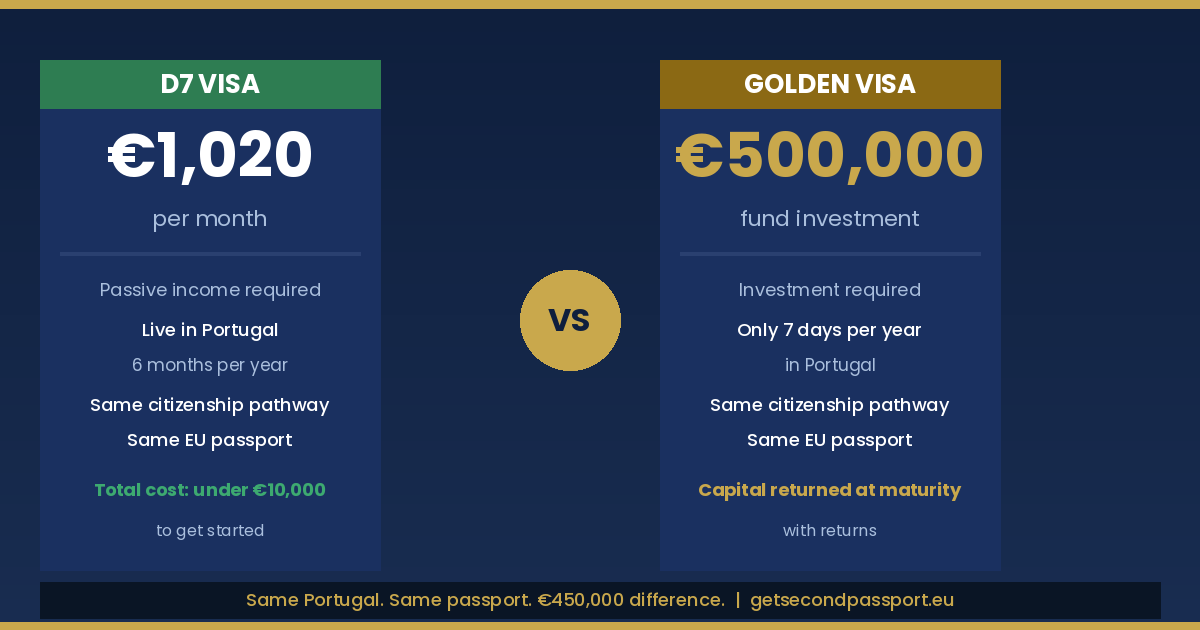
He needed the D7. the D7 does not require €500,000. It requires €920 a month in passive income.
That conversation cost him nothing. The mistake it would have prevented was worth €450,000.
Why This Mistake Happens So Often
The Golden Visa is the most marketed Portugal programme in the investment migration space. It has a clear headline number, €500,000, which makes it easy to sell. Advisors who work on commission from fund managers have a strong incentive to push it. Content online is dominated by Golden Visa guides because the people writing them are often connected to the funds that benefit from it.
The D7 is quieter. It does not involve a fund. There is no commission structure around it. It does not generate the same marketing noise.
So people find the Golden Visa first. They assume it is the route. without a proper first conversation about their actual situation, many of them go all the way to the point of investing before anyone asks the right questions.
What the Golden Visa Actually Is
The Portugal Golden Visa, formally the Autorização de Residência para Atividade de Investimento, is a residency programme for non-EU nationals who make a qualifying investment in Portugal.
The most common route in 2026 is a €500,000 investment into a CMVM-regulated Portuguese fund. The fund must invest at least 60% of its capital into Portuguese companies. Real estate funds no longer qualify.
In exchange for that investment, you receive a Portuguese residence permit. You are required to spend a minimum of seven days per year in Portugal. You do not have to live there. You do not have to change your tax residency. You do not have to relocate.
The Golden Visa is designed for the investor who wants to keep living their current life while Portugal processes quietly in the background.
If that is you, it is an excellent programme. The investment generates returns of between 7% and 15% annually depending on the fund strategy. The capital is returned at fund maturity. The residency clock runs in the background with almost no lifestyle disruption.
But if you actually want to live in Portugal, the Golden Visa is a solution to a problem you do not have.
What the D7 Actually Is
The D7, officially the Visto de Residência para Titular de Rendimentos, was designed for people who have income that does not depend on employment in Portugal. That income must be passive. It must be consistent. it must meet the minimum threshold set by the Portuguese government.
The minimum for a single applicant in 2026 is €920 per month. Add €460 for a spouse and €276 for each dependent child. The figure follows the Portuguese minimum wage, so it changes every January and is expected to rise to €970 in 2027.
Qualifying passive income includes rental income from properties you own, dividends from a business or investment portfolio, returns from financial investments, and pension income.
Once approved, you receive a residence permit that requires you to spend at least six months of the year in Portugal. You are expected to actually be here. That is the trade-off.
But in exchange for being here, you get everything Portugal has to offer. You can open a business. You can hire staff. You can build a property portfolio. You can put your children in Portuguese schools. You can access the Portuguese healthcare system. After five years of continuous residency, you can apply for permanent residency. Citizenship is a longer wait under the current rules, which we come back to below.
Tax Implications: The Part Most People Underestimate
Your physical presence in Portugal determines your tax status, and the difference between the two routes here is significant.
With the Golden Visa, you spend only seven days a year in Portugal, so you generally do not become a Portuguese tax resident. Your global income stays outside the scope of Portuguese taxation.
With the D7, you live in Portugal for more than 183 days a year, so you become a Portuguese tax resident and your global income is subject to Portuguese taxes. This is not necessarily a problem. It is a planning requirement. The people who struggle are the ones who discover it after they arrive rather than before.
A word on the NHR regime: the Non-Habitual Resident framework that offered substantial tax breaks to new residents has been scaled back. A narrower version still exists for specific qualifying professions, but the broad exemptions of the old regime are largely gone. If you are considering the D7, speak to a Portuguese tax advisor before you apply, not after.
Same Destination. Different Route. €450,000 Difference.
This is the part that most people do not understand when they first start researching.
The Golden Visa and the D7 lead to the same place.
Both give you a Portuguese residence permit. Both give you Schengen Area access from day one. Both start the clock toward permanent residency and eventually Portuguese citizenship. Both allow you to include your spouse and children.
The difference is not the destination. The difference is the journey and the cost of the ticket.
The Golden Visa ticket costs €500,000 plus legal fees, government fees, and advisory costs. Total outlay before you receive anything is typically €530,000 to €550,000. The investment is returned at fund maturity, usually seven to ten years, with returns on top. So it is not a pure cost. But it is a significant capital commitment.
The D7 ticket requires passive income of €920 per month. The government fees are under €500. Legal fees are typically €2,500 to €3,500. Advisory fees vary. Your total out of pocket cost for the process itself is well under €10,000.
If you qualify for the D7, the question is simple. Why would you spend €500,000?
The Question That Determines Which Route Is Yours
When someone comes to me asking about the Golden Visa, the first thing I do is ask what they actually want their life in Portugal to look like.
If the answer is that they want to stay where they are, maintain their current lifestyle, keep their existing tax residency, and simply have a Portuguese residence permit building quietly in the background with minimal disruption, the Golden Visa is the right route.
If the answer is that they want to actually live in Portugal, build something there, raise a family there, or use Portugal as their base while they work or invest internationally, the D7 is almost certainly the right route. if they have passive income that meets the threshold, they should use it.
The four questions I ask in every first call are these.
Do you want to live in Portugal or simply hold Portuguese residency?
Do you have passive income of at least €920 per month that you can document?
Are you willing to spend at least six months a year in Portugal?
What is your timeline to citizenship and does it need to be as short as possible?
If you answered yes to questions two and three, and your answer to question one is that you genuinely want to be in Portugal, you do not need the Golden Visa. You need the D7 and a proper strategy.
Who the Golden Visa Is Right For
The Golden Visa makes sense for a specific profile.
You are a high-net-worth investor with €500,000 or more in investable capital that is not already working hard for you.
You want to build Portuguese residency and a path to EU citizenship without changing your current life in any meaningful way.
You travel to Europe regularly and Schengen access matters to your lifestyle or business.
You want the investment to generate returns, which it will. At 10% annually over ten years, a €500,000 investment returns approximately €1.3 million at maturity. The total gain covers all programme costs many times over.
You are not planning to live in Portugal. Seven days a year is your commitment and that is enough.
That investor exists. For that investor the Golden Visa is genuinely excellent. But they are a subset of the people currently researching it.
Who the D7 Is Right For
The D7 makes sense for a much broader profile than most people realise.
You have rental income from properties you own in Nigeria, Ghana, South Africa, the UK, or anywhere else.
You receive dividends from a business you own or have owned.
You have investment returns from a portfolio.
You want to actually live in Portugal, not just hold residency there.
You are building a business and want to do it inside the EU with a Portuguese company structure.
You want your children to grow up with European education and European passports.
You are not trying to keep your current life intact. You are ready for the next chapter.
Most of the people I speak to who start by asking about the Golden Visa are actually D7 candidates. They just did not know it existed as an option. Or they heard the Golden Visa name first and assumed it was the only path.
The D7 is not a second option. For the person who actually wants to live in Portugal, it is the better option. The Golden Visa is designed for the investor who wants to stay away. The D7 is designed for the person who wants to arrive.
What Changed in 2026 and Why It Matters More Now
The new Portuguese Nationality Law came into force on May 19, 2026. It extended the citizenship timeline from five years to ten years for most non-EU, non-CPLP nationals.
This has a particular implication for the Golden Visa.
Under the new law, your ten-year citizenship clock starts from the date AIMA issues your residence card. AIMA is currently taking twelve to twenty-four months to process applications and issue cards. That means the realistic total timeline from application to Portuguese passport for most African and British Golden Visa holders is now twelve to thirteen years.
The D7 clock works the same way. But the D7 holder is physically present in Portugal, which often means they can push their application through AIMA more actively and sometimes faster.
This is not a reason to avoid either programme. It is a reason to be precise about which programme you choose and why, because the commitment you are making is now longer than it was six months ago.
The Conversation That Changes Everything
I stopped someone from wiring €500,000 last week. Not because the Golden Visa was wrong. But because it was wrong for him.
He had rental income. He wanted to live in Portugal. He wanted to build a business there. He wanted his children in Portuguese schools.
The D7 was built for exactly that person.
He did not need €500,000. He needed a clear strategy, the right documentation, and someone who asked the right questions before he made a decision he could not reverse.
That conversation is free.
If you are currently researching the Golden Visa and you have not yet had a conversation with someone who will genuinely look at your income structure, your lifestyle goals, and your family situation before recommending anything, book that call first.
The €500,000 can wait. The strategy cannot.